

- 30 Oct, 2025
- 0 Comments
- 6 Mins Read

Empathy – a powerful tool against bullying
Bullying remains one of the most widespread challenges facing children and young people in schools worldwide. It affects children’s lives well beyond the playground, impacting mental health, academic success, and social relationships into their adult lives. One of the most powerful tools to combat bullying is to teach children empathy. Empathy, the ability to understand and share the feelings of others, plays a critical role in reducing bullying behaviours and promoting a kinder, more inclusive school climate. This blog draws on extensive research to help parents and teachers understand teaching empathy is essential to fight bullying and how it can be effectively nurtured in children.
Understanding empathy and bullying Empathy has two main parts: affective empathy -feeling what another person feels and cognitive empathy – understanding another’s perspective1. It’s important to keep in mind, children involved in bullying aren’t necessarily less capable of empathy than others. However, they often apply it selectively, feeling less empathy for victims or bullies than for those not involved2. This shows empathy isn’t entirely absent but may be unevenly directed. A sense of empathy also can prevent children from becoming bullies and inspire bystanders to intervene3. When children recognise others’ hurt, they’re more likely to act as defenders rather than passive observers.
“Early on I watched a shy child comfort a newcomer after a simple classroom exercise — that moment convinced me empathy lessons change lives,” says Sophie, an experienced teacher and Founder of You Can Sit With Me. “By teaching children to step into another person’s shoes we’re giving them the tools to resist cruelty and to intervene when others are hurt. Over time, those small, everyday choices build kinder, safer schools where every child feels seen.”
Empathy and kindness: how they differ
Although empathy and kindness are closely related they’re not identical. Empathy is an emotional and cognitive capacity meaning, it’s the ability to understand and share another person’s emotional experience.
It includes:
• Affective empathy: the automatic capacity to feel concern or distress when witnessing another person’s pain4.
• Cognitive empathy: the ability to understand why someone feels as they do and to view situations from their perspective5.
Empathy is what drives helpful behaviour and discourages harmful actions like bullying6. Kindness encompasses more as it combines empathy with emotion regulation (the ability manage emotions) and positive action. Malti (2025) describes kindness through the “three Es”: empathy for others, empathy with self, and emotion regulation. It involves both compassion for others and self-directed care such as forgiveness and self-compassion7.
“In my experience, empathy isn’t soft — it’s a powerful skill that protects children and strengthens whole school communities,” Sophie adds. “Too often adults treat empathy as optional; but when we teach children to notice and name feelings, we give them a roadmap for kinder choices.”
In short:
• Empathy is the ability to feel with and understand others.
• Kindness extends this into action, guided by emotional balance and care for self and others.
Why teaching empathy matters
Teaching empathy helps reduce the emotional distance that allows bullying to thrive. In the digital world, cyberbullying often dulls empathy because perpetrators don’t witness victims’ reactions8. Strengthening empathy is vital to counteract the anonymity of online interactions. Empathy training works. The “Media Heroes” classroom programme, which teaches both affective and cognitive empathy, significantly reduced cyberbullying whilst increasing students’ empathic skills9. Such programmes use role-play and discussion to encourage understanding and perspective-taking.
“Seeing a child stand up for a classmate reminds me why this work matters every day,” Sophie reflects. “With consistent practice, empathy becomes a habit that keeps children safer and more connected — online and offline.”
Crucially, empathy reduces moral disengagement, the process that lets individuals justify harmful behaviour without guilt10 (Haddock & Jimerson, 2022, p. 11). Children who learn empathy are less likely to dehumanise peers and more likely to see bullying as unacceptable.
Empathy-building strategies
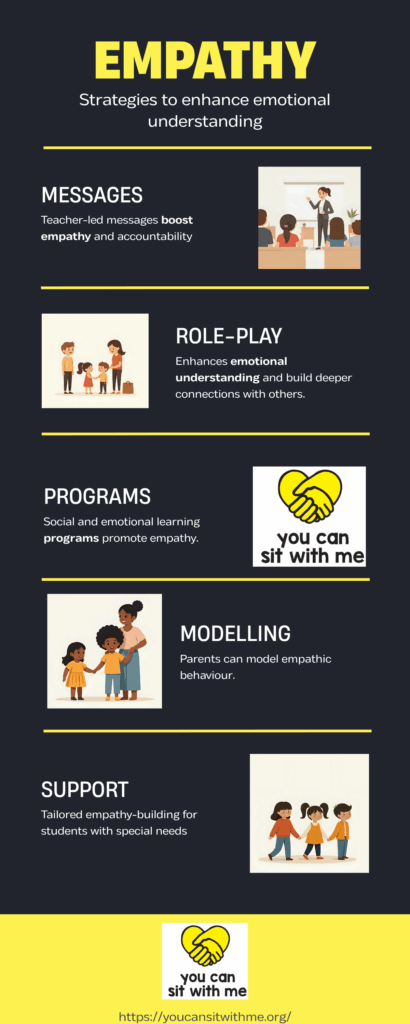
Research identifies several proven approaches:
Teacher-led messages combining empathy and accountability: When teachers condemn bullying whilst also encouraging empathy, students’ intentions to stop bullying rise markedly11.
Role-play and perspective-taking: Helping children imagine how others feel deepens emotional12.
Social and emotional learning (SEL) programmes: These curricula build empathy alongside emotional regulation and problem-solving skills13.
Parental modelling: Parents who discuss emotions and model empathic behaviour reinforce lessons learned at school14.
Support for vulnerable groups: Tailored empathy-building for students with special educational needs improves emotional skills and belonging15.
“Too often adults treat empathy as optional; in my experience, it’s essential,” Sophie notes. “Children who learn to understand others’ feelings are less likely to hurt and more likely to help. We need that understanding woven into teacher training, school policies, and everyday classroom routines.”
Overcoming empathy barriers
Some children struggle with empathy due to callous-unemotional traits, requiring combined approaches that also teach moral reasoning and social skills16. Peer group pressures can also limit empathy, particularly towards children seen as “different” or outsiders. Inclusive classroom cultures help override these17.
Empathy inspires helpful behaviour, empowers bystanders, and helps create caring, safe learning environments aligned with moral education and justice18.
Building empathy every day
Teaching empathy isn’t an optional extra. It’s a cornerstone of effective anti-bullying work. Empathy helps children understand others, handle differences with compassion, and stand up for what’s right.
By integrating empathy training into schools, teacher development, and family life, we can nurture a generation that values kindness and fairness. The result: more respectful friendships, greater emotional wellbeing, and safer schools where every child feels they belong.
“As a teacher I have seen small acts of understanding transform playground dynamics,” Sophie concludes. “When teachers, parents and communities prioritise empathy, we give children the skills to build kinder, fairer schools — and that changes lives.”
YOU CAN SIT WITH ME is an inclusive, evidence-based, peer-led program reducing school refusal, social isolation, bullying, exclusion and non inclusive behaviour.
YOU CAN SIT WITH ME provides free programs for schools, sporting clubs and community groups.
Please consider supporting education for children across Australia. Your generous, fully tax deductible donation can help make a real difference in many young lives. Thank you for your kindness.
You Can Sit With Me has been recognised as a “Tier 1 Preventative Program” in the Australian Government’s Anti‑Bullying Rapid Review Final Report.
[4, 5, 15, 18] Walsh, M. (Ed.). (2024). The Psychology of Cyberbullying. Nova Science Publishers.